|

FOOTWORK
Excerpts from Larry Thoman's Newgy Robo-Pong 2000 Player's Instructional Manual
This chapter
is intended for those who need assistance in moving to the ball. If you can
perform a stroke well while keeping your feet in one spot, but you lose
consistency when you start practicing the stroke with foot movement, then you
need to improve your footwork. When learning footwork, slowly shadow practice
several sets of the described footwork until you get the hang of it. Then
combine practicing footwork with a particular stroke or combination of strokes
using the robot to deliver balls to different points on the table.
Having proper
footwork greatly assists in executing good strokes. With proper footwork, a
player will move into good position and then execute his strokes from a solid,
balanced stance. This leads to consistency, quickness, and being able to use
full power. Without good footwork, a player will reach, lean, and hit the ball
from an unbalanced position. Strokes end up being jerky and erratic, more like
slaps than strokes.
In table
tennis, you won't have to cover a lot of ground, but you will have to
move to a spot very quickly. Therefore, most table tennis footwork consists of
one or two steps, usually fairly short. During all footwork, it is crucial to
stay balanced. Always start your foot movement from the
balanced ready
position.
Place your weight on the balls of your feet with your heels lightly touching the ground. Keep your
shoulders centered over your knees. Eliminate any up and down movement. Move
the instant the opponent has committed to his shot, not before. Move to where
the ball will come before starting your stroke. Avoid stroking while moving.
For
side-to-side movement, you may use one-step, two-step, or three-step footwork.
One-step
footwork is normally used for short distances, two-step for medium distances,
and three-step for long distances. One-step footwork is very common when moving
left to cover a wide backhand. It is performed by simply shifting your weight to
your right leg and pushing your left foot further to the left. Vice versa if you
want to go to the right. One big disadvantage of one-step footwork is it can
leave you in a "stretched out" position if you have to move more than a foot or
two. Once stretched out, it is difficult to get ready for the next shot.
The two-step
footwork is the most common form of footwork. It is used to get into forehand
position for balls to your wide forehand two-step footwork, you lean on your
right leg, pull your left foot toward your right foot, then quickly shift your
right foot to the right. You end up with your feet in the same relative position
as when you started the movement except 2-3 feet further to the right. It is a
side-skipping type of movement.
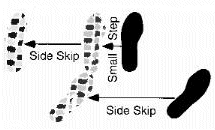
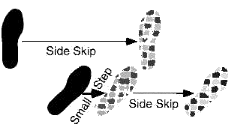
Three-step
footwork is used to cover shots hit deep to the forehand comer, angled off the
wide forehand sideline, or to step out wide on your backhand side to hit a
forehand. It is very similar to the two-step except an additional small step is
made before both feet are shifted. To move right, take a small step with your
right foot to the right (6 to 8 inches), shift your weight to your right leg,
then perform a two-step movement.
Figure
O: Footwork Diagrams
Below are diagrams showing
how to place and move the feet for one-step, two-step, and three-step footwork.
The diagrams are for a right-handed player. You should practice these patterns
until they become second nature. When practicing, remember to stay balanced and
in a good ready position. Strive to keep your shoulders level and on the same
plane (no up and down movement of the body and no dipping or raising of one
shoulder).
|
TO MOVE LEFT |
TO MOVE RIGHT |
|
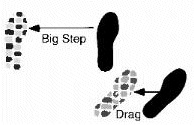 |
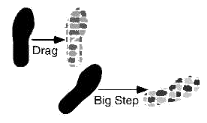 |
|
One Step Footwork |
|
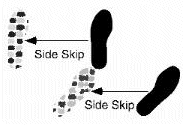 |
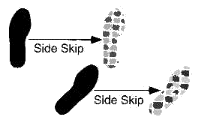 |
|
Two Step Footwork |
|
 |
 |
|
Three Step Footwork |
Courtesy of
Newgy Industries
Copyright © 2002 Newgy Industries. All rights reserved.
|